
Last updated September 10, 2026
Full 25-point door and opener safety check with every visit - springs, cables, rollers, tracks, and your LiftMaster or Chamberlain opener included
You get a price before we start. It does not change when the truck arrives.
 Before
 After
After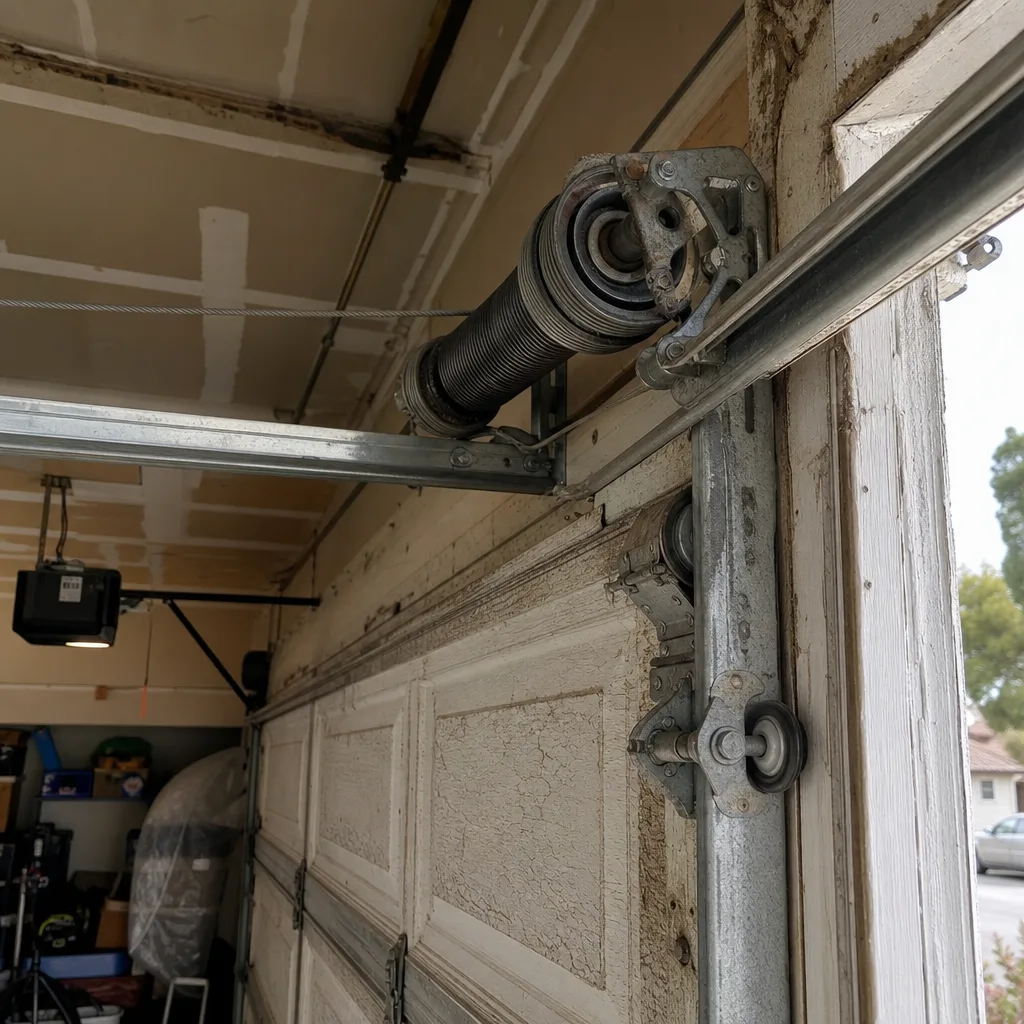 Before
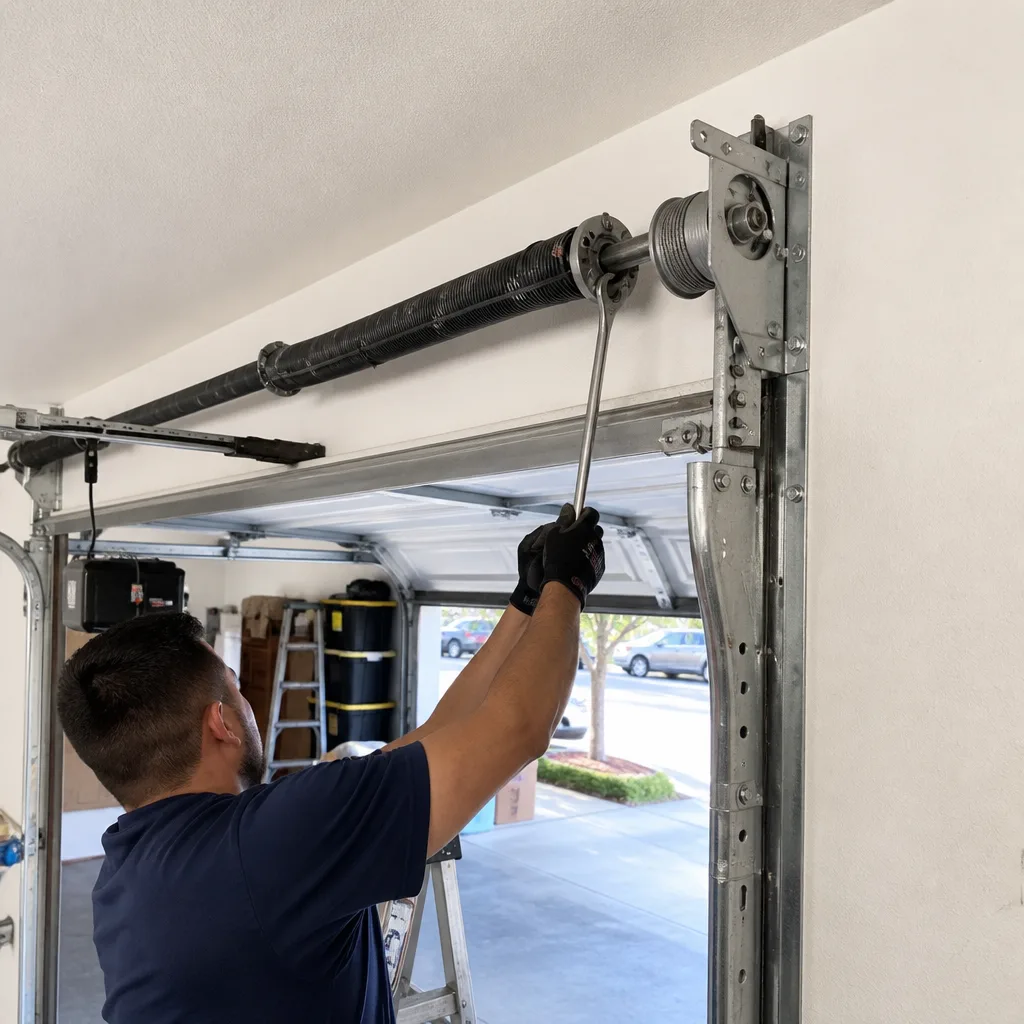 After
After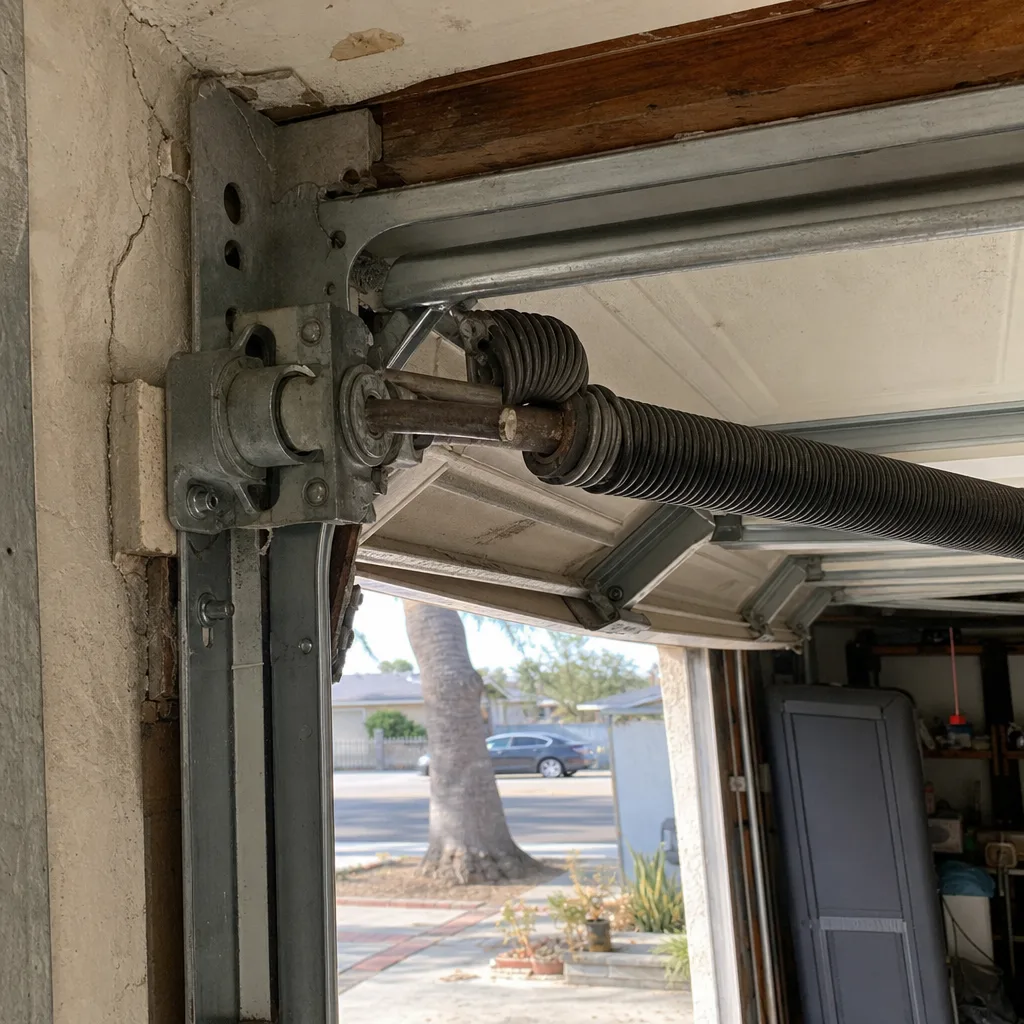 Before
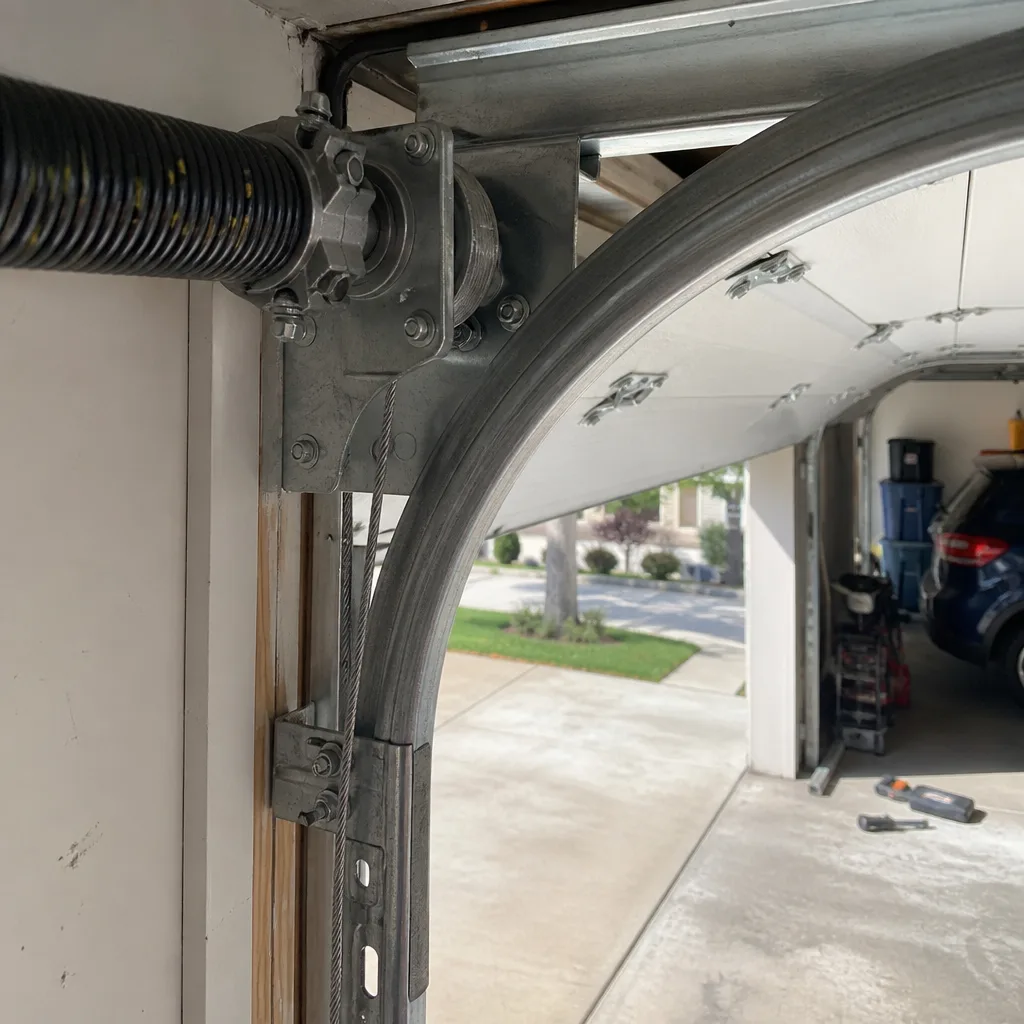 After
AfterGarage Door Repair Maintenance Checklist for Van Nuys Homeowners
The single most common spring failure we see in Van Nuys isn’t from cold. It’s from a summer-long stretch of two-a-day openings during school-year chaos that nobody told the homeowner to factor into their spring’s cycle rating. After 42 years of service calls across the San Fernando Valley, we’ve learned that generic maintenance checklists written for four-season climates send Van Nuys homeowners down the wrong path. For a deeper look at what actually goes wrong locally, see our Garage Door Warning Signs: A Van Nuys Homeowner’s Reference Guide. This guide gives you a month-by-month schedule calibrated to our actual weather patterns, our actual failure modes, and the actual conditions your door faces on a Valley floor that hits 105°F in August and sits under Santa Ana winds that fling gravel against your track seals.
Quick Answer
A proper garage door maintenance checklist for Van Nuys homeowners includes monthly visual inspections of springs, cables, and rollers; quarterly lubrication with white lithium grease formulated for high-heat environments; bi-annual balance and reverse-safety tests; and a professional tune-up every fall before the heavy-use holiday season. Track debris inspection after every Santa Ana wind event is specific to our area and often overlooked. Document everything in a simple cycle-count log to predict spring failure before it strands your car.
Table of Contents
- Why Van Nuys Climate Changes Your Maintenance Schedule
- Monthly Homeowner Checklist: What You Can Safely Do
- Quarterly Tasks: Lubrication and Deep Inspection
- Cycle-Count Tracking: Predicting Spring Failure Before It Happens
- Santa Ana Wind Season: Post-Event Inspection Protocol
- Maintenance Records That Protect Your Insurance Coverage
- What a Professional Fall Tune-Up Covers
- Common Mistakes to Avoid
- When to Call a Professional
- Frequently Asked Questions
Why Van Nuys Climate Changes Your Maintenance Schedule
Most garage door maintenance guides assume you live somewhere with freeze-thaw cycles, rust from road salt, and humidity that swells wooden doors. Van Nuys has none of these. What we have instead is a specific set of stressors that change which parts fail and when.
Heat degradation of lubricants. Standard silicone spray, the go-to recommendation in generic guides, begins to thin and run above 95°F. On a south-facing garage in Lake Balboa or south Van Nuys, your track temperature can exceed 120°F in July. The lubricant migrates downward, leaving upper track sections dry. Within three weeks, rollers start binding. Within two months, the opener motor strains and its logic board overheats. White lithium grease, by contrast, maintains viscosity to 350°F and bonds to metal surfaces rather than pooling.
Thermal expansion cycles. A steel door in Van Nuys expands roughly 1/8 inch per 8-foot panel between a 55°F January morning and a 105°F August afternoon. That daily flexing, repeated 180 days a year, fatigues hinge points faster than in coastal climates with 15-degree daily swings. Hinge bolts loosen. Panel seams separate. The hardware that holds true in Santa Monica may need tighter checking intervals here.
UV exposure on seals and exterior finishes. South Valley homes, particularly in neighborhoods like Valley Glen and the flat streets east of Sepulveda Basin, see some of the highest UV indexes in Los Angeles County. Vinyl door seals become brittle in 3-4 years rather than the 7-8 expected in shaded or coastal areas. Wood-composite doors, including certain Clopay and Amarr models popular in 1990s Van Nuys tract builds, delaminate at the bottom panel where reflected heat from concrete concentrates.
Dust and particulate intrusion. Our dry season runs April through November. Fine Valley dust infiltrates track profiles, roller bearings, and opener chain housings. It acts as grinding compound once lubrication thins. A homeowner in a humid climate deals with rust; we deal with abrasion.
Santa Ana wind events. These are not normal winds. Sustained 40-60 mph gusts, occasionally higher, arrive with dry air and positive ionization that seems to coincide with our busiest emergency call weeks. Wind-borne debris dents door panels, impacts photo-eye sensors out of alignment, and forces grit past compromised seals into the track system.
The maintenance schedule below accounts for all of these. It is not a generic checklist with “Van Nuys” pasted in. It is the schedule our technicians wish every homeowner followed before the 6 a.m. call that the door won’t open and the car is trapped inside.
Monthly Homeowner Checklist: What You Can Safely Do
These twelve checks take ten minutes. Do them on the first Saturday of each month. The goal is spotting change, not fixing it.
Visual Inspection (No Tools Required)
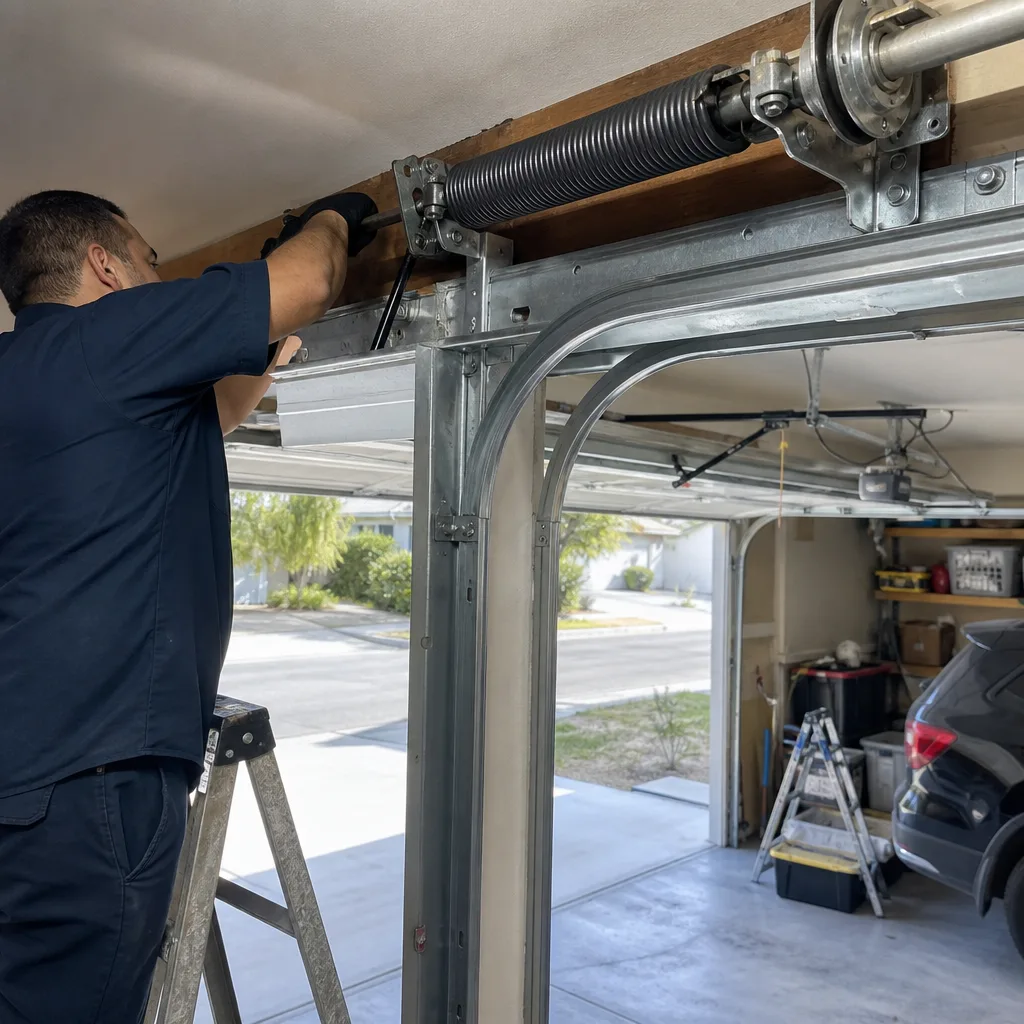
- Spring condition. Stand inside the garage with the door closed. Look at the torsion spring above the door, or the extension springs along the horizontal tracks. You’re checking for: gaps between coils (a stretched spring near failure), rust flaking (rare in our climate but possible near bathroom exhaust vents), and any visible separation in the coil body. A 10-coil gap in a torsion spring means roughly 10% of its tension capacity is gone. Do not touch. Note it and call.
- Cable wear. Follow the lift cables from bottom bracket to drum (torsion) or pulley (extension). Look for fraying, kinking, or any strand separation. Even three broken strands in a 7×19 cable reduce rated strength below safety margins. Cables store enormous energy. Never attempt adjustment or replacement.
- Roller condition. Nylon rollers should roll smoothly, not slide or wobble. Steel rollers should show intact bearings, not grinding noise. Count how many rollers are in your track system (typically 10-12 on a standard door). If more than two show wear, plan replacement.
- Track alignment. The vertical tracks should be plumb; the horizontal tracks should slope slightly down toward the back of the garage. Look for dents, especially after wind events. A dime-sized dent can bind a roller.
- Photo-eye sensors. These sit 4-6 inches above the floor on both sides of the door. LED indicators should be steady, not blinking. Lenses should be clean. Cables should be intact, not chewed by rodents (surprisingly common near the Sepulveda Basin wildlife corridor).
- Weather seal integrity. Close the door and look at the bottom seal from outside. It should contact the concrete evenly, with no gaps for light to pass. Check side and top seals on premium installations. Cracked, flattened, or mouse-chewed seals need replacement before dust season intensifies.
Operational Tests (Two Minutes Each)
- Balance test. Disconnect the opener (pull the red release cord). Lift the door manually to waist height. It should stay there without rising or falling. If it drifts, the spring tension is wrong. This is the most important single test. A door out of balance strains the opener and risks uncontrolled closure.
- Reverse safety test. With the opener reconnected, place a 2×4 flat on the floor centered under the door. Close the door. It should reverse within 2 seconds of contact. If not, the force setting needs adjustment. Federal law (UL 325) requires this function. Your insurance may reference it after an incident.
- Auto-reverse photo-eye test. Close the door. Wave a broomstick through the beam. The door should reverse immediately.
Document in your cycle log. Note the date, which tests passed, and any observations. This paper record becomes evidence of due diligence if an insurance claim ever arises.
Quarterly Tasks: Lubrication and Deep Inspection
Every three months, in March, June, September, and December, spend 30 minutes on deeper maintenance. The timing aligns with seasonal transitions: pre-dust season, peak heat, pre-holiday heavy use, and post-holiday wear assessment.
Lubrication Protocol for High-Heat Environments
Product selection matters more in Van Nuys than almost anywhere else we serve. After testing failures returned to our shop, we specify:
- White lithium grease for hinges, rollers (steel bearing housings only, never nylon wheels), top fixtures, and bottom brackets. It withstands 350°F, resists washout, and stays where sprayed. We use Lubriplate or equivalent NLGI #2 grade.
- Silicone spray only for weather seals to prevent drying and cracking. Never on tracks or rollers in our climate; it attracts dust and turns to grinding paste within six weeks of summer use.
- Light machine oil (SAE 20) for opener chains or screw drives, per manufacturer spec. Most modern LiftMaster and Chamberlain units specify synthetic grease; check your manual.
- Never lubricate the track itself. Rollers need lubrication; tracks need to be clean and dry. Oiled tracks collect dust and cause roller slippage.
Application Steps
- Close the door and disconnect power to the opener.
- Wipe all hinge points, roller stems, and bearings with a clean rag to remove old grease and dust.
- Apply white lithium grease sparingly to each hinge pin and roller bearing. One second of spray per point. Excess grease attracts contamination.
- Operate the door manually through two full cycles to distribute lubricant.
- Reconnect power and test auto-reverse functions.
Hardware Tightening
Thermal expansion loosens hardware over time. With the door closed, check and snug (do not over-torque):
- Hinge bolts to door panels
- Top fixture bolts
- Bottom bracket fasteners (do not remove; these are under spring tension)
- Track mounting brackets to wall and ceiling framing
- Opener rail mounting hardware
Use a socket set, not a screwdriver. Bolts should be firm, not stripped. If a bolt spins freely in a stripped hole, the door has been out of adjustment long enough to wallow the hole. That’s when you need our Garage Door Repair services.
Cycle-Count Tracking: Predicting Spring Failure Before It Happens
Standard torsion springs are rated for 10,000 cycles. High-cycle springs rate 25,000-50,000. A cycle is one full open-and-close. The average Van Nuys household with two working adults and school-age children runs 4-6 cycles daily, higher during summer when kids access the garage for bikes and pool gear. At 5 cycles daily, a 10,000-cycle spring expires in 5.5 years. We’ve replaced springs in Valley Glen homes at 3.5 years because the household ran a home business with constant in-and-out traffic.
The Paper Log Method
We give every tune-up customer a simple card:
- Date of spring installation or last replacement
- Spring cycle rating (10K, 25K, 50K)
- Estimated daily cycles (be honest: count for one week and average)
- Projected replacement date
Update the log monthly with actual cycle estimates. When you hit 80% of rated cycles, schedule replacement. A spring at 8,000 cycles is not “fine.” It’s in the statistical failure zone. Replacing it on your schedule costs $180-$340 and takes 45 minutes. Waiting for failure costs a trapped car, possible door damage, and often an emergency call at the worst possible time.
In our experience, Van Nuys homeowners who keep cycle logs never call at 6 a.m. with a broken spring. They call at 2 p.m. for a convenient appointment. That’s the difference between maintenance and repair.
Santa Ana Wind Season: Post-Event Inspection Protocol
Santa Ana winds typically peak October through January, though we’ve seen destructive events in February and March. A single significant event warrants immediate inspection, not waiting for your monthly schedule.
Post-Wind Checklist (Do This Within 24 Hours)
- Track debris clearing. Remove all leaves, gravel, and construction debris from horizontal and vertical tracks. A single pebble can derail a roller under load. Use a vacuum with a crevice tool, not compressed air (blows debris deeper into bearings).
- Photo-eye realignment. Wind vibration loosens bracket mounts. Check that both sensors face each other squarely. LED indicators should be solid. Blinking indicates misalignment or damage.
- Panel dent inspection. Check each panel from inside and outside. Small dents affect balance; large dents may bind in the track. Aluminum doors dent more easily than steel; insulated steel (common on Wayne Dalton and newer Clopay models) resists better but shows damage differently.
- Seal displacement. Wind can pull bottom seals from retainer channels or tear side seals from their mounting. Gaps here admit dust for months.
- Opener rail stress check. Listen for new grinding or straining during operation. Wind load on a partially open door can twist the opener rail or damage the trolley.
Document wind events in your maintenance log with date and wind speed if known. Insurance adjusters sometimes dispute whether damage was “sudden and accidental” or gradual neglect. A dated entry within 24 hours of a known regional wind event supports your position.
Maintenance Records That Protect Your Insurance Coverage
Homeowner’s insurance covers sudden garage door damage from vehicles, weather, or break-in attempts. It typically excludes damage from “lack of maintenance” or “wear and tear.” The distinction matters when a failed spring drops a door onto a parked car, or a detached cable damages the door and contents.
Insurers increasingly request maintenance documentation for claims over $5,000. A documented record shows due diligence.
What to Record
- Dates of all monthly inspections with checklist items checked
- Dates and products used for lubrication
- Professional service dates, company name, and work performed
- Spring installation or replacement date with cycle rating
- Any observed anomalies and dates reported to a professional
- Santa Ana wind event dates and post-event inspection results
What Creates a Strong Record
Specificity beats generality. “Inspected door, all fine” is weak. “Checked spring coil spacing: 0 gaps visible. Cables: no fraying. Balance test: door held at waist height. Lubricated 10 hinge points with white lithium grease. Photo-eyes: steady green LEDs.” That’s a record an adjuster or court accepts.
Store records with your homeowner’s insurance policy. Update annually. If you sell the home, this documentation transfers as evidence of care, supporting your sale price.
Our Garage Door Repair in Van Nuys service includes written documentation of every visit for this purpose. The 90-Day Done Right Promise paperwork also serves as professional maintenance evidence.
What a Professional Fall Tune-Up Covers
Even diligent homeowners need professional service annually. We schedule Van Nuys tune-ups in September and October, before holiday storage access, visitor parking, and the gift-wrap-and-decorations cycle that doubles door use.
Our $89 Seasonal Tune-Up includes:
- Full spring tension measurement with calibrated gauge (not visual guesswork)
- Cable drum inspection and set-screw torque verification
- Roller replacement assessment; we carry standard sizes on every truck
- Opener force-limit and travel-limit adjustment to manufacturer spec
- Photo-eye alignment with laser gauge
- Track plumb and level check; minor adjustments as needed
- Weather seal replacement recommendation with measured sizing
- Cycle-count update and projected replacement date calculation
- Written condition report with photo documentation
Major adjustments requiring spring tension changes, cable replacement, or bottom bracket work are quoted separately with upfront pricing before any work begins. No surprises on the bill.
The fall timing is deliberate. Springs that survive summer heat stress often fail in the first cold snap (relatively speaking: our “cold” is 45°F, but that’s enough thermal contraction to finish a fatigued spring). Catching weakness in October prevents a December 23rd emergency.
For new door considerations, see our Garage Door Installation in Van Nuys page. For opener-specific service, our Garage Door Opener in Van Nuys page covers chain, belt, and screw drive maintenance.
Common Mistakes to Avoid
- Using silicone spray on tracks or rollers in summer heat. It migrates, attracts dust, and turns to abrasive sludge within weeks. We’ve replaced dozens of opener gears in July that failed because of this exact mistake.
- Ignoring the balance test because the opener “still works.” An opener lifting an unbalanced door is running at 150-200% rated load. The motor overheats. The logic board fails. The safety reverse may not trigger properly. The $200 spring adjustment prevents the $600 opener replacement.
- Waiting for a spring to break completely. A gap-coiled spring is a failed spring that hasn’t snapped yet. When it goes, it often damages the door, the opener, or whatever is beneath it. Replace at 80% of cycle rating, not 100%.
- Pressure-washing the door and track system. Water forced into roller bearings displaces lubricant and initiates corrosion in our hard-water environment. Clean with a damp cloth and mild detergent only.
- DIY spring adjustment or cable replacement. Torsion springs store enough energy to cause serious injury or death. Extension springs under load can whip with lethal force. These are not homeowner tasks in any jurisdiction, including Van Nuys. The Los Angeles County Building Code requires licensed contractors for spring work on attached garages.
- Neglecting post-wind inspection because “it still opens.” We’ve responded to calls three weeks after a Santa Ana event where a small track dent progressively worsened until the door derailed completely, bending two panels and the top fixture. The immediate inspection would have caught a $120 track adjustment instead of a $1,400 door rebuild.
- Assuming all brands maintain the same way. A Craftsman chain-drive opener from 2008 needs different care than a current LiftMaster belt-drive with MyQ connectivity. A Wayne Dalton TorqueMaster spring system (common in 1990s Van Nuys builds) requires specialized tools and knowledge. Follow manufacturer guidelines, not generic advice.
When to Call a Professional
Call when you observe: any gap in a torsion spring coil; any fraying in lift cables; a door that fails the balance test; a door that reverses erratically or not at all; grinding or binding during operation; visible track damage; or any damage after a wind event. These are not “watch and wait” conditions.
Carl Dutton and the team at Mainspring Garage Door Co. home offer free estimates in Van Nuys. A technician arrives with a fully stocked truck, assesses your door, and states a flat price before any work begins. Most repairs finish in a single visit. Call (747) 836-1998. If you have a written estimate from another company, we’ll provide a free second opinion.
Frequently Asked Questions
Our Seasonal Tune-Up is $89 and includes full spring tension measurement, cable and roller inspection, opener adjustment, photo-eye alignment, track check, and a written condition report. If we find issues requiring repair, we quote upfront before any additional work begins. Call (747) 836-1998 to schedule, or read How to Hire a Garage Door Contractor in Van Nuys: A Step-by-Step Guide to prepare.
Quarterly, using white lithium grease on metal-to-metal contact points and silicone spray only on weather seals. In our high-heat climate, standard lubricants break down faster than in milder regions. The March, June, September, December schedule aligns with seasonal stress points.
No. Torsion springs store lethal energy and require specialized winding bars and training. Extension springs under tension can whip unpredictably. Los Angeles County requires licensed contractors for spring work on attached garages. We’ve seen serious injuries from DIY attempts. This is a trained professional task, period.
Heat thins lubricant, causing metal-on-metal contact. Thermal expansion also changes clearances between moving parts. The solution is proper high-temperature lubricant selection and more frequent application during July and August. If noise persists after lubrication, the opener may be straining against an out-of-balance door.
A standard 10,000-cycle spring lasts 5-6 years at average use. High-traffic households may see 3-4 years. The heat itself doesn’t directly degrade springs, but thermal expansion stress and dust abrasion accelerate wear. Our cycle-count tracking method lets you predict replacement before failure.
Documented maintenance supports claims for sudden damage and may be required for claims over $5,000. Lack of maintenance can void coverage for damage attributed to neglect. Keep dated records of inspections, lubrication, and professional service. Our written tune-up reports serve as formal documentation.
The Bottom Line
Garage door maintenance in Van Nuys is not about following a generic checklist. It’s about understanding how our specific climate, usage patterns, and wind events create failure modes that Midwest guides never mention. The homeowners who never call us in panic are the ones who: run monthly ten-minute inspections, use white lithium grease suited to 105°F track temperatures, keep a cycle-count log that predicts spring replacement, inspect after every Santa Ana wind, and schedule a professional fall tune-up before the heavy-use holidays. The work is not complicated. It is specific. And specificity is what keeps a door running quietly for twenty years instead of failing at the worst possible moment. For more guides & resources, explore our blog.
Written by Carl Dutton, Owner at Mainspring Garage Door Co., serving Van Nuys since 2016.